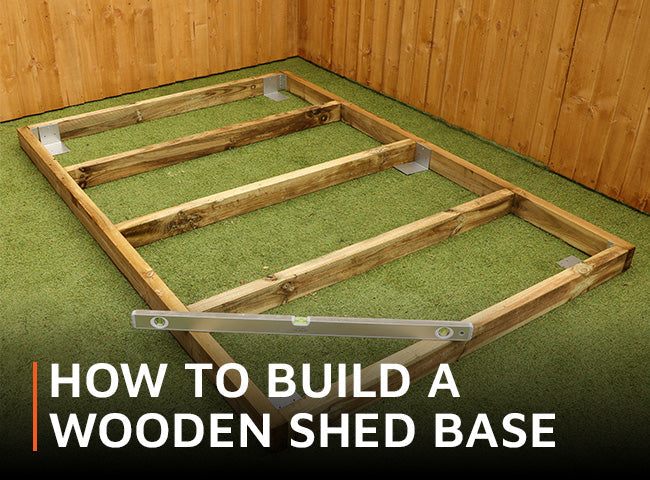
Building a Base
NEW Walton's Portabase
This is a new unique concept designed by Walton Garden Buildings. The base is a time and cost saving solution for your sheds. The base is available for the 6' x 4', 7' x 5', 7' x 7', 8' x 6', 10' x 6' and 10' x 8'. The portabase price varies depending on the size you require. The price is available on each product page shown as an option.
Tick the Portabase in options when you buy your shed and it will be delivered at the same time. Made of Pressure Treated Timbers that when made up is the same size as your building floor. Once constructed the Portabase is fastened into the ground (i.e. grass or soft soil) with metal posts. Metal support brackets are supplied to level your Portabase on your driveway or patio. Once levelled, the Portabase provides a solid support for your garden building.

When buying a timber garden building, whether it a shed, Workshop or Summerhouse, you must always consider what base you are going to erect it on. Some customers may be replacing an old building hence they will already have a base in situ, however many won’t and will require one of the following:- 1. Concrete Base 2. Slab base 3. Pressure treated bearers.
The obvious issues with concrete and slab bases is both in cost and labour time, bearers are a far cheaper option and require less labour, however they are really only suitable for smaller buildings (6x4 & 7x5), and still only be laid on very firm and level ground. The Walton's Portabase you have a unique alternative to the traditional methods.
The main benefits include
- Easy and quick to assemble - Easy to level - Require minimum tools and practical skills - No mixing of concrete or laying of slabs - Minimal ground preparation - Exceptional ground anchorage that bearers can not provide - Pressure Treated to protect against rot & decay with 10 year Guarantee - Can accommodate any size of building, big or small - Delivered to the doorstep with Building |
|
 |
The Portabase can be laid onto lawns / firm soil with corner spikes or laid onto hard standings areas such as drive ways and patios, using footplates that can be positioned to level the Portabase to compensate for any discrepancies in the hard surface levels. Can accommodate up to 2” variance (more if blocked with additional packers under base feet).
Laying Base on a lawnViews Showing base used to create level stage for erection of building on a lawn using corner spikes     Close up of steel anchor spike
RECOMMENDATIONS FOR BUILDING A BASE FOR A GARDEN BUILDING
Introduction
Assembling a shed / workshop / summerhouse may seem like an overwhelming task to a DIY novice. However if a level, sound and sturdy base is provided the rest should be simple. Making the base for a garden building is an easy task for a single person to complete. However we recommend two or more people are available to assemble the garden building.
Planning permission is normally not required for a prefabricated garden building. However, if you live in a conservation area, you may wish to check with your local council prior to construction. Planning where the building should go
Consider the optimum site for your garden building in terms of:
• Access to where the building is going to be assembled for the delivery team. • Access to all sides of the building once erected for applying wood treatments, maintenance etc. • Surrounding area conditions (Foliage, young trees that may grow in future, areas open to extreme elements etc.) • Natural light (a light area is best if the building is to be used as a workshop for example) • View from the assembled building (for summerhouses etc.) • Is an electrical supply going to be installed to the building and does it give any implications?
Types of Suitable Base
It is essential to provide a solid and level base. Attempting to assemble a garden building on an unlevel or soft surface will incur difficulties in squaring the building up when putting on the roof and doors will often not close properly. We recommend the following 4 types of base:
• A Paving Slab Base • A Concrete Base • Tanalised Bearers • Portabase – A new concept in shed building, exclusive to Walton Garden Buildings click here to purchase
Whichever method is more suitable, we strongly recommend that your base be made to the same measurements as the floor of the garden building you are assembling. This allows the majority of rain to run off the walls and roof and soak-away instead of pooling on the base under the building and effectively creating dampness and rot problems.
Concrete Base
Tools Required:
• Pegs and string • Sand and gravel mix • Hardcore • Standard cement • Timber for base formwork • Tape measure • Spade • Sweeping brush • Cement mixer • Spot – mixing board • Wheel barrow • Tamp board • Spirit level.
Step 1:
Decide where to position the shed in an optimal space, allow enough distance from hedges or fences for easy access to all sides. Using pegs and string to mark out the base the same area as the building's floor. Finally, measure diagonals to ensure the area is square.
Step 2:
A concrete base requires 3 inch (7.5 cm) of compacted hardcore underneath the 3 inch (7.5 cm) concrete layer. The base can be level with the ground or raised above it. If it is to be level excavate the top earth to 6 inch (15 cm) to allow for the hardcore layer and 3 inch (7.5 cm) thickness of concrete. Level the area with a rake and spade and remove the pegs.
Step 3:
Set up levelled formwork. This involves measuring, cutting and fitting timber, to the shape of the base in order to contain the concrete (as shown in the diagram). Check diagonals to ensure the formwork is square. And also ensure the formwork is level, as this will determine whether your base is 100% level. Next, spread a layer of well compacted hardcore and cover with a liberal amount of sand.
Step 4:
Next, mix concrete using one part cement to five parts ballast or use bags of dry-mixed concrete to which you just add water. Small amounts of water should be added at a time and mixed into the concrete mix to ensure excessive amounts are not added making the cement sloppy, as the concrete should be kept on the dry side.
Spread the concrete evenly and slightly proud of the formwork. This can be then levelled off with a long straight edge of timber resting on the formwork using a sawing motion slowly (as shown below) over the entire surface of the freshly laid concrete.
If wet weather is forecast, cover the concrete with polythene for 24-hours. In warm weather cover the base with damp sacks and sprinkle them with water over the 24-hour period, this will ensure the drying concrete will not shrink and crack.
The result is a smooth, sound, level base. The perfect foundation for the construction of a garden building. Allow 48 hours for the concrete to set prior to assembling your building.
Slab Base
Tools Required:
• Pegs and string • Flat Face Paving Slabs • Sharp sand • Standard cement, rake • Tape measure • Spade • Rubber mallet • Sweeping brush • Spirit level
Step 1:
As mentioned above, decide where to position the shed in an optimal space. Allow enough distance from hedges or fences for easy access to all sides. Using pegs and string to mark out the base the same area as the building's floor. Finally, measure the diagonals to ensure the area is square.
Step 2:
Strip the topsoil and dig out to a depth of approx. 2.5 inch (7 cm) to accommodate the base. Level the area and remove the pegs.
Step 3:
Mix together one part cement to eight parts building sand for a dry sand and cement mix. Spread this evenly ensuring that the mix sits approx. 4 cm in depth. Now, rake this to a level.
Step 4:
Starting from one corner and working outward, lay the slabs by tapping down on the centre of each slab with a rubber mallet. Using a spirit level, ensure all the slabs are square, level and firmly butted together for a solid base.
Step 5:
The completed base should now be level and square. Do one final check with a long straight edge to check if the base is level from each corner, and also measure the diagonals to finally check the base is square. Brush off any excess dry sand/cement mix, which could hinder the leveling of the shed. The result is a smooth, sound, level base. The perfect foundation for the construction of a garden building.
Tanalised Bearers Base
Tools Required:
• Pegs and string • Tape measure • Spade • Rubber mallet • Spirit level • Hardcore (crushed lime stone) • 75mm x 75mm Tanalised Bearers
Step 1:
As mentioned above, decide where to position the shed in an optimal space. Allow enough distance from hedges or fences for easy access to all sides. Using pegs and string to mark out the base the same area as the building's floor. Finally, measure the diagonals to ensure the area is square. Step 2:
Strip the topsoil and dig out to a depth of approx. 3 inch (7.5 cm) to accommodate the base. Level the area and remove the pegs.
Step 3:
Fill the trench with hardcore and compact down as level as possible.
Step 4:
Lay the bearers on the hardcore, 16 inches (40cm) apart. The bearers should be laid at 90 degrees to the building's floor joists, i.e. if the floor joists run from side to side of the building then the bearers will need to run the length of the building. Check the orientation of the floor joists on your building as they do vary from building to building. Using the spirit level and rubber hammer, tap the bearers into the hardcore until they are perfectly level.
|