In this guide
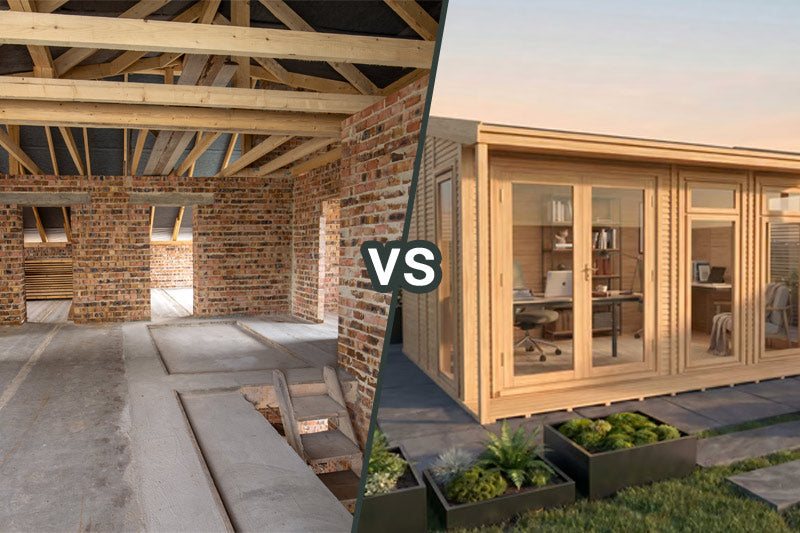
A garden room can offer a more affordable, quicker and less disruptive way to create extra space on your property for a home office, gym or hobby room, whilst a house extension is generally better if you want to enlarge an existing living space or add another bedroom.
Both options have their advantages, and the right choice depends on your intended use of the space and your budget. In this article, we compare the advantages and disadvantages of garden rooms and extensions to help you decide which option is best suited to your needs.
Garden Room vs Extension: At a Glance
To get started, here’s a quick breakdown of the pros and cons of all the main considerations when deciding between a garden room and an extension.
|
Factor |
Garden Room |
House Extension |
|
Cost |
Generally lower |
Generally higher |
|
Installation |
Often quicker |
Usually takes longer |
|
Disruption |
Work takes place outside |
Can affect existing living space |
|
Planning permission |
Falls under permitted development |
It depends, and will require building regulations approval |
|
Best For |
Office space, studio, gym, hobby room, entertainment space |
Kitchens, bedrooms, extra living space |
|
Insulation |
Depends on model |
Must meet building standards |
|
Access |
External from house |
Internal home space |
|
Property value |
May improve buyer appeal |
Adds overall value |
How Much Does a Garden Room Cost Compared to an Extension?
One of the biggest considerations when choosing a garden room or extension is cost. Generally, a garden room costs less because it does not require the same amount of construction, planning and structural work as an extension. However, the total cost should not automatically deter you from choosing an extension if it ultimately suits your needs better.
Waltons' DIY insulated garden rooms start at £4,750, whilst the Classic insulated garden rooms start at around £6,050. These prices provide a useful starting point, although the final cost will vary depending on any additional features, internet and electricity connections, and interior furnishings. Waltons offers a wide selection of garden rooms in various sizes to suit different budgets.
By comparison, the cost of an extension is typically significantly higher than that of a garden room. Checkatrade’s house extension cost guide estimates that a typical UK extension costs around £1,800-£3,000 per square metre, excluding VAT. This means that a 20m² extension could cost approximately £36,000-£60,000 before VAT, with additional costs potentially arising from delays, extra work and interior finishing.
Remember that neither the initial advertised price of a garden room nor that of a home extension necessarily reflects the full cost of the project. There are many factors, both minor and major, that need to be considered financially throughout the process. However, if your sole priority is keeping your budget as low as possible, a garden room is likely to be the better option.

Planning Permission and Building Regulations
Neither garden rooms nor house extensions always require planning permission. In England, both may fall under permitted development rights, provided they meet the relevant requirements. However, it is always recommended that you check with your local authority, as the rules depend on the type of building, its location, dimensions and intended use.
Garden rooms are typically treated as outbuildings and generally do not require planning permission when used for purposes incidental to the enjoyment of the main house. Restrictions do apply, however, to their height, position and the overall percentage of the garden they occupy. It is also worth noting that listed buildings and designated areas may have additional requirements. If you intend to use the garden room as accommodation, this can also affect the planning position.
Extensions can also be built under permitted development rights. However, the rules and regulations tend to be more demanding, with eligibility depending on factors such as the extension's height, size and location.
It is important to note that planning permission and building regulations are not the same thing and involve different considerations. Building regulations address matters such as structural safety, insulation, fire safety and ventilation. In some cases, smaller outbuildings may be exempt from certain requirements, whereas most extensions require building regulations approval.
Always check the rules that apply to your property before making any important purchases or starting work. You can do this by consulting the official Planning Portal advice website and checking with your local authority.

Which Is Quicker to Build – a Garden Room or an Extension?
A garden room is typically much easier to install because of the materials and labour required. Many models use prefabricated components or modular panels, meaning they can be assembled more easily than a home extension, which involves major alterations to the property.
Waltons offers professional installation for its garden rooms, with the exception of the self-build DIY collection. Installation is included in the price of the Classic and Premium insulated models. If you wish to construct the garden room yourself or fancy taking on a satisfying DIY project, see our self-build DIY collection, where you can assemble the building alongside friends or other DIY enthusiasts.
An extension typically involves more stages, including foundations, structural work, connecting the new space and potentially demolishing existing walls. Although the result is additional space inside the house, the work may temporarily prevent you from accessing certain rooms, such as the kitchen or living room.
The timescale for both options depends on the design, preparation, weather and complexity of the project. However, if you require additional space with minimal disruption, a garden room can be a more attractive option.
Which Option Is Best for Your Needs?
The best option depends on what you want your new space to achieve. The first step is to consider whether the additional area is better suited to the interior of your house or can be created in an outdoor building, as well as how conveniently you need to access it.
Garden Room vs Extension for a Home Office
Garden rooms can be particularly useful for a dedicated home office. Their separate location creates distance between your work and home life, providing one space for personal use and another for working. A garden room can also provide a separate area for meeting clients face to face, giving you a dedicated workspace that you can step away from at the end of the working day.
An extension may be more convenient if you prefer direct access to your office from inside the house, particularly if you frequently move between rooms. It can also allow you to expand an existing workroom, especially if you have a lot of equipment or custom setups that need to fit the layout of your current space.
Garden Room vs Extension for a Home Gym or Hobby Room
A garden room can be an excellent choice for a home gym, art studio, music room or other hobby space, allowing you to arrange the interior around your equipment and activities without taking up too much space in your home.
The biggest considerations when creating a gym or creative space are the available floor area and proper ventilation. Whether you’re working out or painting a canvas, it is important to maintain a suitable temperature so that exercising does not become difficult or your creative supplies are not damaged. Waltons' garden rooms come with fully insulated walls, floors and ceilings, as well as double-glazed windows, helping you control the temperature throughout the year.
A house extension can offer similar benefits, but you may prefer to keep exercise equipment or creative projects separate from the house, especially if they involve a lot of noise or fragile equipment that is better kept secure. Your budget and the available space in your garden can help you determine the best option in this case.

Garden Room vs Extension for Additional Living Space
If you want to enlarge your kitchen, create another bedroom or extend your living room, a home extension is generally the better choice. It connects to the existing house, allowing you to expand your current living space and create a more integrated layout.
Garden rooms are generally better suited to those who want to separate recreational or working spaces from the main house. Perhaps you want to create a social hub for hosting friends, in which case a garden room can be a great option because it provides a dedicated area. However, if you wish to entertain people inside your home, a house extension may be the better way forward.
In this case, it is important to think carefully about your needs and your long-term plans for your home and outdoor space before committing to either an extension or a garden room.
Do Garden Rooms or Extensions Add More Value to Your Home?
Both options may make your property more attractive to potential buyers, but neither guarantees a specific increase in overall value. The result depends on the location, the quality of the work, the available space and what prospective buyers are looking for.
An extension adds usable internal accommodation, making it attractive to buyers who are looking for a larger kitchen, a more spacious living area or additional bedrooms. However, the cost of building an extension does not automatically translate into an equivalent increase in resale value.
A well-designed garden room offers some similar benefits and can be especially attractive to buyers looking for a home office, workspace or recreational area. However, its usefulness will depend on the quality of its construction, insulation and access, as well as its condition when you sell your home.
If resale value is important to you, it is recommended that you choose a practical design and location for either a home extension or garden room, invest in high-quality workmanship, and ensure that both options comply with the relevant planning and building requirements.
Garden Room vs Extension: Which Should You Choose?
The right choice will depend on your priorities and how you wish to use your additional space.
Choose a garden room if…
- You need a separate home office, gym, studio or hobby room.
- You want to minimise disruption in your main home.
- You have suitable garden space and meet the relevant requirements for an outdoor building.
- You want to keep your budget lower.
- You would like a dedicated space away from the main house.
Choose an extension if…
- You want to enlarge an existing space, such as the kitchen or living room.
- You need additional bedrooms or integrated family space.
- Direct access from the main house is a priority.
- Your planned extension meets all the relevant building requirements.
- You wish to change the current layout or functionality of your existing home.+

Conclusion
Ultimately, the choice between a garden room and a home extension depends on your budget, available space and how you plan to use the extra room. A garden room can provide a practical, cost-effective way to create extra space without causing significant disruption to your home, whereas a home extension can provide integrated living space and allow you to enlarge existing rooms.
Whatever you decide, Waltons recommends considering your needs and long-term plans to help you determine which option is best suited to you.
FAQs
Is a garden room cheaper than an extension?
Generally, yes. Garden rooms usually cost less because they require less structural work and labour, and can be installed separately from the house. Waltons' garden rooms start at a significantly lower price than a typical home extension, whilst still offering many of the benefits of creating additional space.
Can a garden room be used all year round?
Yes, an insulated garden room is designed for use all year round. Waltons' garden rooms come equipped with insulated floors, walls and roofs, tongue-and-groove panelling, and double-glazed windows to help maintain a regulated temperature throughout the year.
Does a garden room count as an extension?
No, a detached garden room is generally classed as an outbuilding rather than an extension. However, the rules, regulations and classifications for outdoor buildings depend on your location, the type of building and the requirements of your local authority. We recommend checking with your local council before purchasing or installing a garden room.
Will a garden room add value to my property?
A garden room can improve buyer appeal, but there is no guarantee that it will increase your home's value. Any effect on resale value depends on various factors, such as the property's location, the quality of the building and local demand.
Published